Big Dirt Has Got You By the Root Hairs
- William Mount
- Mar 12
- 5 min read
Updated: May 8
How an Underground Cabal Monetizes Your Futile Hopes.
Do you own more than one hoe? An anvil pruner? A dibble?
Do you begin each season with visions of a verdant lawn? Beds and containers overflowing with flowers? Borders of regimented greenery? When it all grows leggy from too much sun or rots from too much water, do you swear to yourself, “Next season…”?
Have you ever driven to a store and bought a bag of dirt?
Stop and think about that for one second.
You bought a bag of dirt. Something that is literally on the ground all around us. Dirt is something we work assiduously to remove from our homes, but you made a special trip to buy more of it and put it back on the ground.
If you answered “yes” to any of these questions, chances are you’re already in the clutches of Big Dirt.
For generations gardening has been peddled as a wholesome pursuit: a tranquil pastime, a way to “connect with nature” and “cultivate your soul.”
But what if I told you this image is nothing but a mulch of propaganda, diligently spread by the shadowy cabal known as Big Dirt?
Beneath those rhododendrons and marigolds lies a sprawling network of fertilizer conglomerates, plastic pot mafias, seed cartels, lawnmower lobbies, plant nursery syndicates and, perhaps most insidiously, the media itself.
Their goal? To keep you placidly puttering in your yard, distracted by weeds, blissfully ignorant of their true machinations.
It’s time to rip up the sod and expose the truth:
Gardening is terrible.
You're a victim of the greatest conspiracy since sliced bread (which, incidentally, also requires wheat. More profitable acreage for Big Ag.)
The Dirty Truth
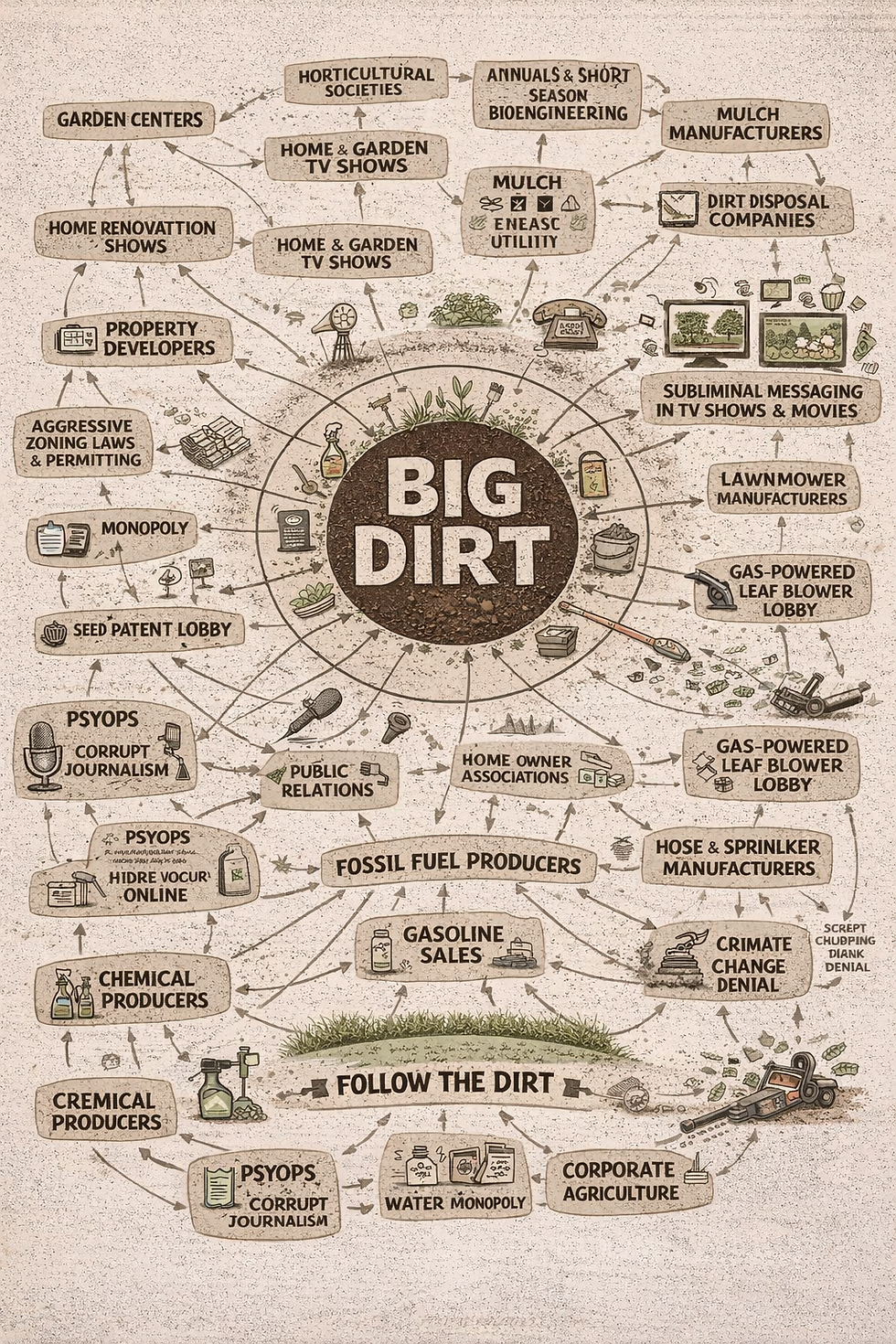
Big Oil keeps us hooked on internal combustion engines and fossil fuel. Big Food fattens us up with ultraprocessed mac and cheese, Froot Loops and frozen “chicken” nuggets. Then Big Pharma arrives right on cue with miracle drugs like GLP-1 inhibitors to help us shed the lard Big Food bequeathed us. Provided, of course, you can shell out about $1,000 a month.
It’s a tidy system. One industry creates a problem. Another sells the solution. A third bills you for the side effects. And this is precisely the sort of vertically integrated racket Big Dirt has been quietly cultivating right under our noses.
Or rather, right under our feet.
Exhibit A: “Fall Is For Planting”
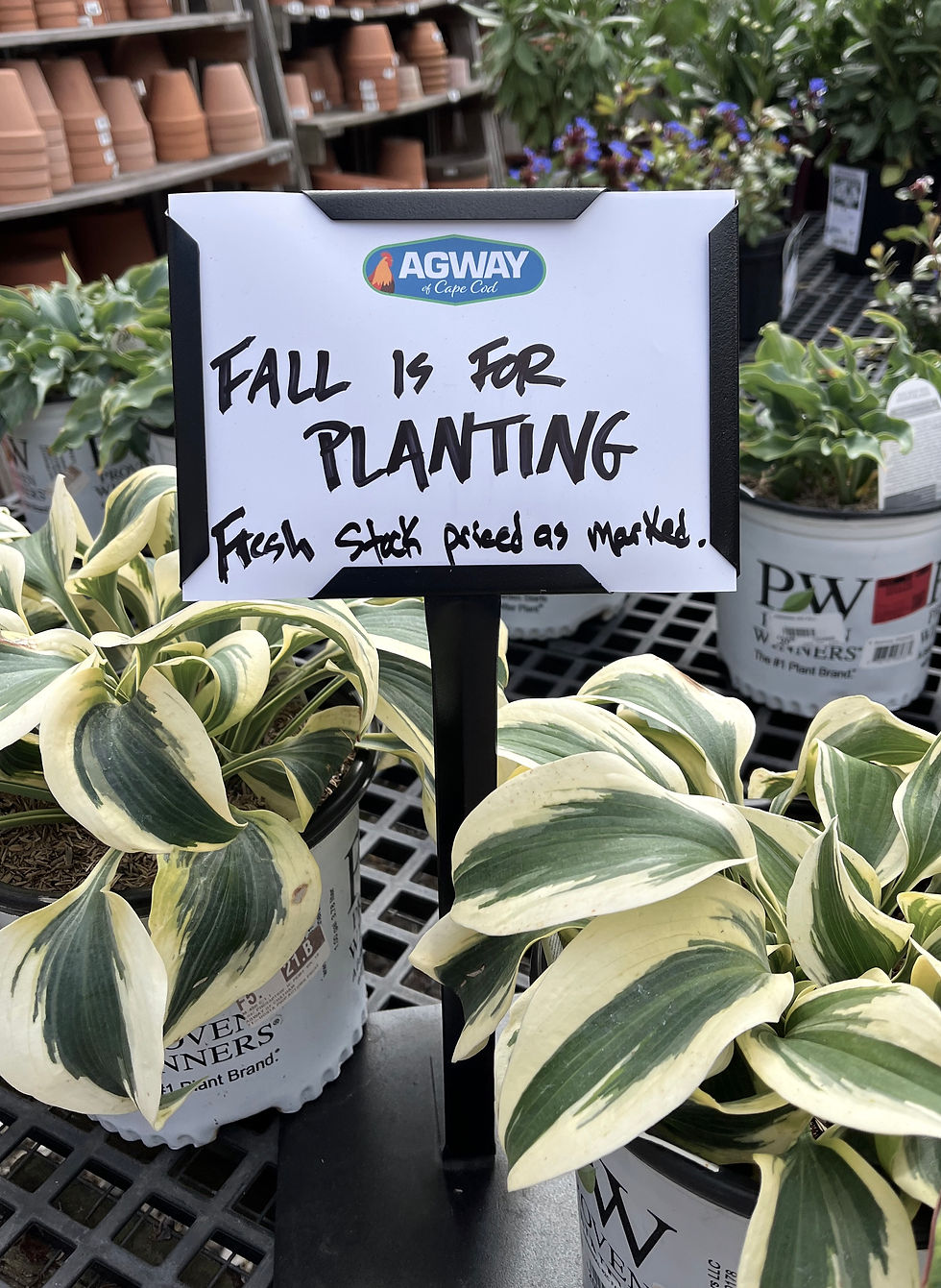
A few months ago I spotted a sign at a garden center on Cape Cod:
FALL IS FOR PLANTING
If you believe Big Dirt, it’s never not time for planting. Spring is for planting. Fall is for planting. Summer is for labor. Winter is for guilt.
No one says: “Hello, I am a multi-industry consortium here to drain your wallet by converting your seasonal joy into endless labor and psychological pain.”
Instead they say:
“Fall is for planting.”
And you nod like a trained seal and buy more mums, asters, ornamental kale, sedum and whatever else is allegedly “perfect for this time of year.”
Gardening: Planned Obsolescence Perfected
Planned obsolescence usually hides in electronics. Phones that slow down. Printers that refuse to print. Appliances engineered to fail just outside the warranty window.
Gardening improves on the model. In gardening, obsolescence is the point. Even when you succeed, the success is temporary by design. Annuals die on cue. Soil is declared “spent.” Nutrients “leach out.” Mulch decomposes. Tools grow dull. Beds must be cleared. Pots must be emptied.
The garden ends every year, right on schedule.
And because the whole cycle is framed as “nature,” consumers never get angry.
They just get hopeful.
Cui Bono?
Whenever a system feels inevitable, ask the oldest question: Who benefits?
Seed companies benefit from annual replacement.
Growers benefit from fragile starts.
Soil companies benefit from permanent deficiency.
Tool companies benefit from seasonal desperation.
Mower manufacturers benefit from lawn guilt.
Media outlets benefit from endless “10 Things You Must Do In Your Garden This Weekend” content.
Garden centers benefit from being church and casino at the same time.
And you, hearty gardener, benefit because you believe that “gardening is good for you.”
The Media Watering Can
In the summer of 2025, The New York Times published an article explaining the physical and mental benefits of gardening. It included passages like:
“Gardening, as numerous studies have found, is good for us. The shoveling and weed-pulling, the exposure to fresh air and sunshine, the sensory engagement with nature — all of that is believed to lower rates of hypertension and heart disease and improve mental well-being.”
“Some of the more vigorous gardening activities, like digging, raking and hauling bags of potting soil, can also serve as a strength workout.”
I don’t mean to imply that The New York Times, the venerable Gray Lady and one of the last authoritative news organizations extant, is in the pocket of Big Dirt.
But I spent close to four decades in the advertising business and I never crafted more seductive copy than that.
The Cult of Cultivation
A couple of years ago a friend of mine, a smart, educated, accomplished woman, went on a camping vacation. Already outdoors, already surrounded by nature, she asked the campground director if she could pull weeds from a decorative planting bed.
She didn’t miss her garden. She missed labor.
That’s not a hobby. That’s horticultural Stockholm syndrome.
At a certain point the system no longer needs to persuade you. You begin to label yourself.
Plant person. Garden nerd. Dirt worshipper.

No one puts a sticker on their car that says: PROUD DAILY FLOSSER
But gardeners? They wave their flag, They evangelize. Because, even if they don't know it, they want us all to be as pathetically soil-bound as they are.
Stress Is the Fertilizer
Winston Churchill supposedly said, “Never let a good crisis go to waste.” No organization hews more closely to that principle than Big Dirt.
The modern rise in home gardening traces back to the Victory Gardens of World War II. Governments encouraged citizens to till, toil and plant vegetables for the war effort. This is more than gardening, this was shooting the wheels off the Axis War Machine one packet of cabbage seeds at a time.
Once the war ended and abundance returned, Big Dirt faced a challenge:
How do you keep people digging? The answer was simple. figure out the next crisis.
Whenever the world becomes unstable, gardening surges.

Pandemics. Economic anxiety. Climate dread. Political chaos. When the universe feels unhinged, people reach for something controllable. A pot. A plot. A tiny kingdom where cause and effect still appear to work.
And Big Dirt will be right there waiting, ready to hand you a shovel.
Now, it might be going too far to suggest that Big Dirt actively nudges global crises in directions favorable to soil-adjacent commerce. But numbers don’t lie. When the world spins out of control, people start buying dirt.


Comments